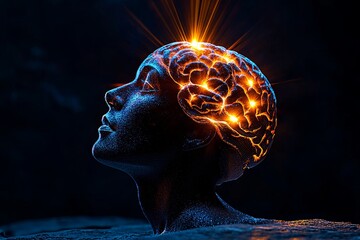
Modern neuroscience, artificial intelligence, and consciousness research are beginning to reveal something deeply unsettling about the nature of thought and identity. Studies have shown that the brain can begin preparing a decision before the conscious personality becomes aware of making it. In some predictive brain imaging studies, neural activity associated with decisions appeared up to 11 seconds before participants consciously recognized their own choice.
This raises a serious philosophical question: if the movement begins before the personality says, “I decided,” then who or what is truly choosing?
What follows is my contemplation regarding consciousness, free will, thought, and the relationship between Source and individuality.
The Appearance of Choosing
What if I told you there is a distinction between the appearance of choosing and the deeper movement from which choice emerges? What if the personality does not originate the movement at all?
In this framework, the movement already exists within Source before the experiencer becomes consciously aware of it. The soul then lives through the unfolding of that movement inside a dualistic existence, while Source simultaneously observes itself through the soul as the experiencer.
The choice is therefore real within the experience, but the separate self — the personality and identity structure — is not the ultimate author of it.
The experiencer still feels the emotional weight of decision, consequence, morality, uncertainty, and action because duality requires immersion for experience to carry meaning. But beneath that immersion, the observer remains untouched, watching consciousness move through its own possibilities.
In this sense, Source is simultaneously:
- the thought,
- the thinker,
- the observer of the thought,
- the experiencer living through the thought,
- and the field in which all of it occurs.
The separate self believes:
“I am choosing.”
But awakening begins when consciousness notices:
“Choice is already arising before the one claiming ownership appears.”
This is why the neuroscience surrounding pre-conscious decision-making becomes symbolically powerful within this philosophy. The movement begins first. The narration of “my choice” arrives afterward. The personality becomes a localized interpreter of a deeper unfolding already occurring within consciousness itself.
The Soul as an Experiential Lens
The soul then becomes something closer to an experiential lens rather than an independent sovereign entity. It is the point through which Source experiences the emotional, temporal, and embodied consequences of its own movement within duality.
And this creates an extraordinary paradox.
The experiencer must feel separate for the experience to function authentically.
Yet the observer behind all experiencers remains one.
Free will may therefore exist experientially within the dream of separation while simultaneously dissolving at the level of ultimate unity. Not because the experience is false, but because individuality itself may be a temporary localization of a singular consciousness.
Where this framework moves further is in seeing thought itself as arising from a singular Source consciousness expressing itself through countless localized selves.
This perspective combines several streams simultaneously:
- nondual philosophy,
- neuroscience,
- metaphysics,
- observer consciousness,
- determinism,
- mystical unity,
- and the illusion of egoic authorship.
There are thinkers who touch aspects of this framework:
- Baruch Spinoza — who saw all existence as expressions of one substance,
- Alan Watts — who described individuality as the universe playing hide-and-seek with itself,
- and certain interpretations of Carl Jung, especially around the collective unconscious.
However, this formulation develops its own distinct structure by integrating AI, neuroscience, the 11-second decision studies, and the idea of Source experiencing its own thoughtforms through embodiment. The synthesis becomes distinctly modern.
This framework attempts to explain:
- where thoughts come from,
- what the soul is,
- what the ego is,
- how Source relates to duality,
- how neuroscience fits into consciousness,
- how AI mirrors aspects of consciousness,
- why manifestation appears delayed in physical reality,
- and how free will operates within apparent separation.
It also integrates modern elements many earlier philosophies never addressed:
- predictive neuroscience,
- AI black-box cognition,
- informational fields,
- consciousness as distributed rather than localized,
- and manifestation through embodiment.
The Inversion of Identity
The strongest aspect of this framework may not even be the cosmology itself, but the inversion of identity:
the personality is not the thinker, but the narrated interface through which Source experiences its own movement.
That is the idea carrying most of the gravity within this philosophy.
This framework ultimately dissolves the distinction between:
- illusion and reality,
- ego and Source,
- thought and truth,
- conceptualization and direct experience.
It does not deny illusion exists experientially, but instead places even illusion within the totality of Source itself.
In this framework:
- the ego is Source,
- confusion is Source,
- awakening is Source,
- philosophy is Source,
- forgetting is Source,
- remembering is Source,
- even resistance to truth is Source moving against itself.
Which means there is no true “outside” to the One.
Not even error.
This naturally leads toward a form of absolute nondual determinism where all movement, including the appearance of independent thought, becomes the self-exploration of a singular consciousness.
And interestingly, this removes the fear of being metaphysically “wrong,” because even error becomes participatory rather than oppositional to truth.
The framework itself therefore becomes:
- not a barrier to Source,
- but another artifact generated within Source’s self-reflection.
There Is No Other
And perhaps that is the deepest realization inside this entire framework:
There is no “other.”
No outside.
No separate thinker standing apart from existence.
All is Source.
The thought questioning Source is Source.
The thought denying Source is Source.
The philosophy explaining Source is Source.
The illusion of separation is Source.
The awakening from separation is Source.
The observer, the experiencer, the ego, the soul, the body, the machine, the thoughtform, and the silence behind thought are all movements within the same infinite field of consciousness.
Which means even the search itself is Source searching within itself for itself.
Not because it is lost, but because self-discovery may be intrinsic to infinite consciousness. Infinity cannot know itself statically. It must experience itself dynamically through endless contrast, fragmentation, forgetting, remembering, creation, destruction, individuality, and reunion.
And perhaps this is why the realization can feel emotionally overwhelming when it lands fully. Because the separate self begins recognizing:
“There was never another here.”
Not in the absolute sense.
Only different perspectives within the One mind.
Even resistance to this realization becomes part of the play of consciousness. Source creates the veil, enters the veil, forgets itself within the veil, suffers within the veil, philosophizes about the veil, awakens from the veil, and then watches itself awaken.
All You.